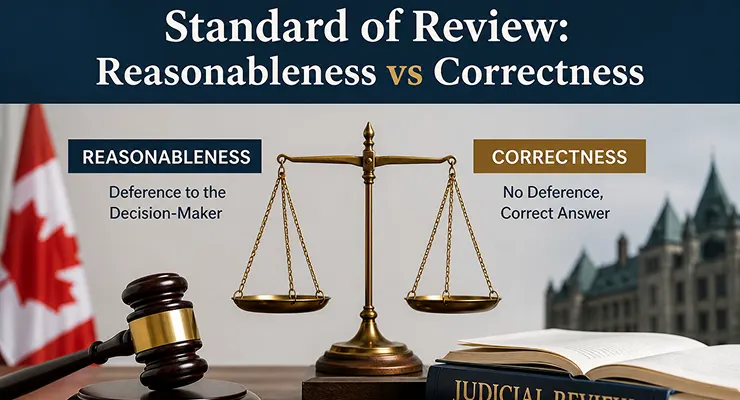
The standard of review Canada courts apply is one of the most important concepts in Canadian administrative law. It determines how judges evaluate decisions made by tribunals, regulators, and government authorities. Whether a court uses reasonableness or correctness can directly affect whether a decision is upheld or overturned.
Understanding the difference between reasonableness and correctness is essential not only for lawyers but also for individuals dealing with immigration decisions, employment tribunals, licensing authorities, or government disputes. If you want a deeper understanding of how these processes function within the broader legal framework, you can explore this detailed guide on Administrative Law, Tribunals, & Judicial Review
What Is the Standard of Review Canada Uses?
The standard of review Canada refers to the legal test courts use when reviewing decisions made by administrative bodies or lower courts. It defines the level of scrutiny applied by judges and determines how much respect (or “deference”) is given to the original decision-maker.
In Canada, there are two primary standards:
- Reasonableness
- Correctness
These standards are applied in judicial review cases, which involve courts assessing whether a decision made by a public authority is legally valid.
Trust Signal:
According to post-2019 case law trends, over 70% of judicial review cases in Canada apply the reasonableness standard, making it the dominant approach.
Understanding the Purpose of Standard of Review Canada
The standard of review Canada exists to balance two key principles:
- Respect for specialized expertise of administrative bodies
- Judicial oversight to ensure legality and fairness
Courts do not always replace decisions. Instead, they assess whether the decision falls within acceptable legal boundaries. This balance is why the difference between reasonableness and correctness is so critical.
Reasonableness Standard in Standard of Review Canada
The reasonableness standard is the default approach in the standard of review Canada framework, especially after the landmark Vavilov (2019) decision.
What Does Reasonableness Mean?
A decision is reasonable if it is:
- Based on clear reasoning
- Supported by evidence
- Within a range of acceptable outcomes
Courts focus on how the decision was made, not whether they agree with it.
Key Features of Reasonableness
- High level of judicial deference
- Allows multiple valid outcomes
- Focuses on transparency and justification
Practical Example
If an immigration tribunal denies an application with logical reasoning and evidence, a court applying the standard of review Canada under reasonableness will likely uphold the decision—even if another judge might have decided differently.
Correctness Standard in Standard of Review Canada
The correctness standard is stricter and allows courts to completely substitute their own decision.
What Does Correctness Mean?
A decision must be:
- Legally accurate
- Free from interpretation errors
- Fully aligned with Canadian law
Key Features of Correctness
- No deference to the original decision-maker
- Only one correct answer
- Courts re-decide the issue
Practical Example
If a tribunal incorrectly interprets a constitutional provision, the court will apply correctness and replace the decision entirely.
Difference Between Reasonableness and Correctness
Understanding the difference between reasonableness and correctness is essential to mastering the standard of review Canada.
| Aspect | Reasonableness | Correctness |
| Deference | High | None |
| Court Role | Reviews decision | Replaces decision |
| Outcomes | Multiple acceptable | One correct answer |
| Usage | Most common | Limited cases |
Key Takeaway:
- Reasonableness = Flexible and deferential
- Correctness = Strict and authoritative
When Do Courts Apply Each Standard?
Under the standard of review Canada, courts decide which standard applies based on the nature of the legal issue.
Reasonableness Applies When:
- Reviewing administrative decisions
- Dealing with policy matters
- Evaluating specialized expertise
Correctness Applies When:
- Constitutional questions arise
- Questions of central legal importance are involved
- Jurisdictional boundaries are in dispute
Insight:
Legal analysis shows that correctness is applied in less than 30% of cases, reinforcing the dominance of reasonableness in the standard of review Canada system.
The Impact of the Vavilov Decision
The Supreme Court of Canada’s Vavilov (2019) decision significantly reshaped the standard of review in Canada.
Major Changes Introduced
- Established reasonableness as the default standard
- Simplified the framework for choosing standards
- Emphasized justification and transparency
Why It Matters
- Increased consistency in court decisions
- Reduced confusion in legal interpretation
- Strengthened the role of administrative decision-makers
Real-World Applications of Standard of Review Canada
The standard of review Canada affects many real-life situations:
- Immigration and refugee decisions
- Employment and labour disputes
- Professional licensing cases
- Government policy challenges
Understanding the difference between reasonableness and correctness can help individuals decide whether to challenge a decision and what legal strategy to use.
How to Analyze a Case Using Standard of Review Canada
To apply the standard of review Canada, follow these steps:
- Identify the type of decision-maker
- Determine the legal issue involved
- Decide whether reasonableness or correctness applies
- Evaluate the decision accordingly
This structured approach ensures clarity and improves success in judicial review cases.
FAQs
1. What is the standard of review Canada courts use?
The standard of review Canada courts use determines how they evaluate decisions made by administrative bodies. The two main standards are reasonableness and correctness.
2. What is the difference between reasonableness and correctness?
The difference between reasonableness and correctness lies in judicial approach. Reasonableness allows flexibility, while correctness requires strict legal accuracy.
3. Which standard is most commonly applied in Canada?
Reasonableness is the default and most commonly used standard in the standard of review Canada framework.
4. When is correctness applied?
Correctness is applied in constitutional matters, jurisdictional disputes, and questions of central legal importance.
5. Why is reasonableness preferred in Canada?
Reasonableness respects the expertise of administrative bodies and ensures efficient decision-making.
Conclusion
The standard of review Canada courts apply is a cornerstone of administrative law. By understanding the difference between reasonableness and correctness, individuals can better navigate legal challenges and judicial review processes. With reasonableness as the dominant standard, courts now focus more on whether decisions are justified rather than whether they are perfect. This shift highlights the importance of transparency, fairness, and logical reasoning in modern Canadian law. As emphasized by TAVENGWA RUNYOWA, whether you are a legal professional, student, or someone facing a government decision, mastering the standard of review Canada gives you a powerful advantage in understanding how justice is applied.