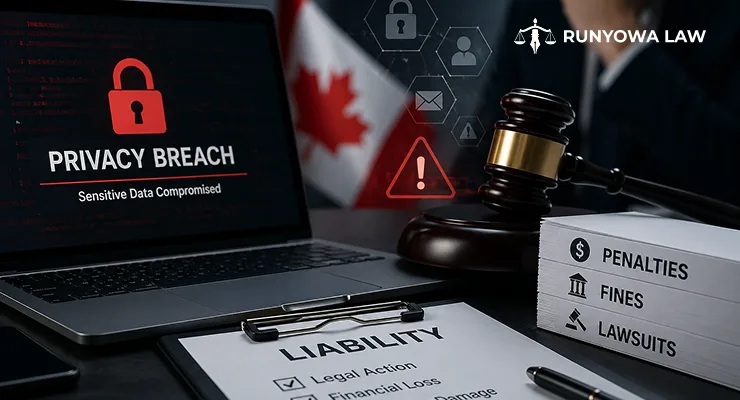
Data privacy is no longer just a compliance checkbox—it’s a core business risk. With rising cyber incidents and stricter regulations, organizations must understand privacy breach penalties Canada and prepare for the legal, financial, and reputational consequences.
In Canada, privacy laws impose serious obligations on businesses handling personal data, often governed under broader frameworks like administrative law and tribunals. When a breach occurs, the consequences go far beyond technical fixes. From regulatory fines to lawsuits, understanding what happens after a data breach Canada is critical for risk management and long-term sustainability.
Understanding Privacy Laws in Canada
Canada has a well-defined legal framework for data protection. The primary federal law is the Personal Information Protection and Electronic Documents Act (PIPEDA). In addition, provinces like Quebec, Alberta, and British Columbia have their own privacy regulations.
Key Legal Requirements
Organizations must:
- Protect personal information using appropriate safeguards
- Report breaches that pose a “real risk of significant harm”
- Notify affected individuals promptly
- Maintain records of all breaches
Failing to meet these obligations is where privacy breach penalties Canada begins to apply.
Privacy Breaches via Cyber Incidents
Privacy breaches via cyber incidents—such as ransomware, phishing, and system hacks—can expose sensitive data instantly. Understanding these risks helps reduce privacy breach penalties Canada and prepares businesses for what happens after a data breach Canada.
What Happens After a Data Breach Canada: Step-by-Step
Understanding what happens after a data breach Canada helps businesses act quickly and reduce liability.
1. Immediate Containment
Organizations must stop the breach immediately—this includes isolating affected systems and preventing further data exposure.
2. Risk Assessment
Businesses must evaluate whether the breach creates a “real risk of significant harm,” such as identity theft, financial loss, or reputational damage.
3. Mandatory Reporting
If the risk threshold is met:
- Report to the Office of the Privacy Commissioner of Canada (OPC)
- Notify affected individuals
- Inform third parties (like banks or credit agencies) if necessary
4. Documentation
Even if the breach is minor, companies must keep detailed records. Failure to document can itself lead to penalties.
5. Investigation & Remediation
Organizations must investigate root causes and implement corrective actions such as:
- Upgrading cybersecurity systems
- Employee training
- Policy updates
Privacy Breach Penalties Canada: Financial Consequences
One of the most critical aspects of privacy breach penalties Canada is financial liability.
Regulatory Fines
Under PIPEDA:
- Failure to report a breach can result in fines up to CAD $100,000 per violation
- Each affected individual may count as a separate violation
With newer laws like Quebec’s Law 25:
- Penalties can reach CAD $25 million or 4% of global revenue, whichever is higher
Real-World Data Points
- The average cost of a data breach in Canada is approximately CAD $6.9 million (IBM Security Report)
- Detection and escalation alone account for nearly 50% of breach costs
- Businesses take an average of 200+ days to identify a breach
These numbers highlight why understanding what happens after a data breach Canada is essential for financial planning.
Legal Liability: Beyond Regulatory Fines
Fines are only part of the equation. Legal liability significantly increases the impact of privacy breach penalties Canada.
Class-Action Lawsuits
Affected individuals can file lawsuits for:
- Emotional distress
- Financial losses
- Negligence in data protection
Recent cases in Canada have resulted in settlements ranging from millions to tens of millions of dollars.
Contractual Liability
If a company handles third-party data (e.g., vendors or partners), it may face:
- Breach of contract claims
- Indemnity obligations
- Loss of business relationships
Director & Officer Liability
In severe cases, executives may be held accountable if negligence or lack of oversight is proven.
Reputational Damage: The Hidden Cost
While financial penalties are measurable, reputational damage is harder to quantify but equally severe.
Impact on Business
- Loss of customer trust
- Decreased sales and conversions
- Negative media coverage
Studies show that companies lose up to 30% of customers after a major breach.
Understanding what happens after a data breach Canada includes recognizing that rebuilding trust can take years.
Industry-Specific Risks
Different industries face varying levels of privacy breach penalties Canada depending on the sensitivity of data.
Healthcare
- Highly sensitive patient data
- Strict compliance requirements
- Higher likelihood of lawsuits
Financial Services
- Direct financial risk
- Mandatory reporting to regulators
- Increased scrutiny
E-commerce & Retail
- Payment data exposure
- High customer churn after breaches
Organizations in these sectors must be especially proactive in managing what happens after a data breach in Canada.
How Organizations Can Reduce Liability
Preventing breaches is always more cost-effective than dealing with privacy breach penalties Canada.
1. Implement Strong Security Measures
- Encryption and multi-factor authentication
- Regular vulnerability assessments
- Secure cloud infrastructure
2. Employee Training
Human error causes nearly 80% of breaches. Training employees on phishing and data handling is critical.
3. Incident Response Plan
Have a clear plan that outlines:
- Roles and responsibilities
- Communication strategy
- Legal compliance steps
4. Regular Audits
Conduct privacy impact assessments (PIAs) to identify risks before they become breaches.
The Role of Compliance in Risk Reduction
Compliance is not just about avoiding fines—it’s about building resilience.
Benefits of Compliance
- Reduced likelihood of breaches
- Faster response times
- Lower legal exposure
Organizations that prioritize compliance are better prepared for what happens after a data breach Canada, minimizing both penalties and operational disruption.
Future Trends in Privacy Breach Penalties Canada
The regulatory landscape is evolving rapidly.
What to Expect
- Higher fines and stricter enforcement
- Increased focus on AI and data usage
- Greater accountability for executives
As laws become stricter, privacy breach penalties Canada will likely increase, making proactive compliance essential.
FAQs
1. What are the main privacy breach penalties in Canada?
Privacy breach penalties Canada include fines up to CAD $100,000 per violation under PIPEDA and up to CAD $25 million under stricter provincial laws like Quebec’s Law 25.
2. What happens after a data breach in Canada?
What happens after a data breach Canada includes containment, risk assessment, mandatory reporting, notifying affected individuals, and implementing corrective measures.
3. Can companies be sued after a data breach in Canada?
Yes, organizations can face class-action lawsuits for negligence, emotional distress, and financial damages, increasing overall liability.
4. How long does it take to detect a data breach?
On average, it takes over 200 days to identify a breach, increasing the overall cost and impact.
5. How can businesses avoid privacy breach penalties Canada?
Businesses can reduce risk by implementing strong cybersecurity measures, training employees, maintaining compliance, and having an incident response plan.
Conclusion
Privacy breaches are no longer rare—they are inevitable risks in a digital-first world. The real question is not if a breach will happen, but how prepared your organization is to respond.
Understanding privacy breach penalties Canada and knowing what happens after a data breach Canada can make the difference between a manageable incident and a catastrophic failure. From regulatory fines to lawsuits and reputational damage, the consequences are far-reaching.
Organizations that invest in compliance, cybersecurity, and proactive risk management are better positioned to navigate these challenges. In today’s regulatory environment, preparedness is not optional—it’s a business necessity.