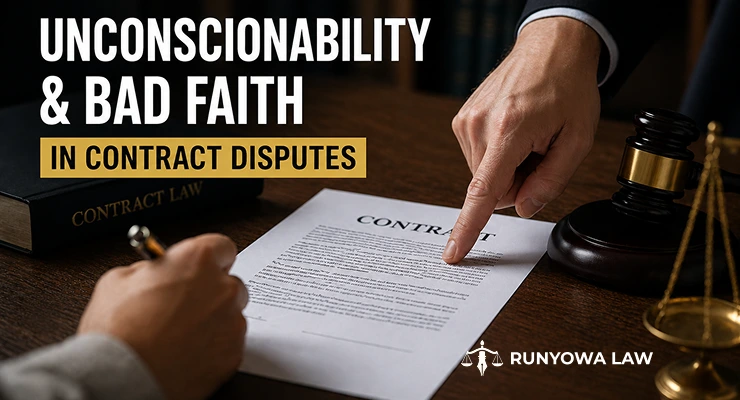
In Canadian law, disputes often arise when one party feels treated unfairly or misled. The doctrines of bad faith contract Canada and unconscionable contract Canada play a crucial role in resolving these issues. Whether you are a business owner, employee, or consumer, understanding these legal principles can help you protect your rights and avoid costly legal consequences.
A bad faith contract Canada situation occurs when one party acts dishonestly or unfairly, while an unconscionable contract Canada refers to agreements that are extremely one-sided or exploitative. With contract disputes rising across Canada, these concepts are more important than ever. Insights from legal professionals such as TAVENGWA RUNYOWA further highlight the importance of fairness and transparency in modern contract law.
Understanding Bad Faith Contract Canada
The concept of bad faith contract Canada refers to dishonest, misleading, or unfair conduct by one party during the execution or enforcement of a contract.
Duty of Honest Performance
Canadian law requires all parties to act honestly in contractual dealings. This includes:
- Avoiding false statements
- Not misleading the other party
- Acting in good faith when fulfilling obligations
Failure to meet these standards may result in legal liability.
Example of Bad Faith
If a company intentionally delays fulfilling a contract while falsely assuring compliance, this may qualify as a bad faith contract Canada, making them responsible for damages.
What Is an Unconscionable Contract Canada?
An unconscionable contract Canada occurs when an agreement is so unfair that it becomes legally questionable.
Key Characteristics
Courts typically look for:
- Inequality of bargaining power
- One-sided or unfair terms
- Exploitation of vulnerability
Example
A contract that forces a financially struggling individual into extremely high-interest repayment terms could be considered an unconscionable contract Canada.
Difference Between Bad Faith and Unconscionability
Understanding the distinction is essential:
| Aspect | Bad Faith Contract Canada | Unconscionable Contract Canada |
| Focus | Behavior during contract | Terms of the agreement |
| Issue | Dishonesty or intent | Unfairness or imbalance |
| Outcome | Damages or penalties | Contract may be voided |
In simple terms:
- Bad faith contract Canada = unfair actions
- Unconscionable contract Canada = unfair agreement
Legal Remedies in Canada
If a court identifies a bad faith contract Canada or an unconscionable contract Canada, several remedies may apply:
1. Financial Damages
Compensation for losses caused by dishonest actions.
2. Contract Cancellation
Courts may cancel an unconscionable contract in Canada entirely.
3. Modification of Terms
Unfair clauses may be adjusted to ensure fairness.
4. Punitive Damages
Additional penalties may be imposed in severe bad faith contract Canada cases.
Common Scenarios in Canada
- Employment Contracts
Employers acting unfairly during termination may face bad faith contract Canada claims.
- Consumer Agreements
Hidden fees or misleading clauses can result in an unconscionable contract Canada dispute.
- Business Contracts
Partnership conflicts often involve allegations of bad faith behavior.
- Insurance Claims
Unjustified denial of claims is a common example of bad faith contract Canada.
How to Prove Bad Faith Contract Canada
To establish a bad faith contract Canada claim, you should provide:
- Evidence of dishonest or misleading behavior
- Written communications (emails, messages)
- Proof of financial or reputational harm
Maintaining proper documentation is critical for success.
How to Identify an Unconscionable Contract Canada
You may be dealing with an unconscionable contract Canada if:
- You were pressured into signing
- Terms were unclear or hidden
- The agreement heavily favors one party
- You had little or no negotiation power
Red Flags
- Extremely one-sided clauses
- Excessive penalties
- Exploitation of financial distress
Prevention Strategies
1. Ensure Transparency
Clearly explain all terms before signing.
2. Maintain Fair Negotiations
Avoid taking advantage of weaker parties.
3. Document Agreements
Keep detailed records of discussions.
4. Seek Legal Advice
Professional guidance helps prevent disputes.
Why This Matters in Canada
Contract disputes are increasing across Canada due to greater awareness of legal rights. Courts are placing more emphasis on fairness and accountability.
- Consumer complaints have increased significantly
- Employment-related disputes are rising
- Businesses are focusing more on legal compliance
Understanding bad faith contract Canada and unconscionable contract Canada is essential in today’s legal environment.
FAQs
1. What is a bad faith contract in Canada?
A bad faith contract Canada involves dishonest or misleading actions by one party during a contract.
2. What makes a contract unconscionable in Canada?
An unconscionable contract Canada involves unequal bargaining power and unfair terms.
3. Can a contract be voided in Canada?
Yes, courts may cancel an unconscionable contract in Canada or penalize bad faith actions.
4. How do I prove bad faith in a contract?
You must show evidence of dishonesty and resulting harm.
5. Are these laws the same across Canada?
Yes, although application may vary slightly by province.
Conclusion
The principles of bad faith contract Canada and unconscionable contract Canada are essential safeguards in modern contract law. They ensure that agreements are not only legally binding but also fair and ethical.By understanding these doctrines, recognizing warning signs, and taking preventive measures, individuals and businesses can protect themselves from unfair practices. In Canada’s evolving legal landscape, fairness and transparency are no longer optional—they are fundamental requirements for every contract. To learn more about resolving legal issues, explore this detailed guide on contract dispute solutions in Canada.