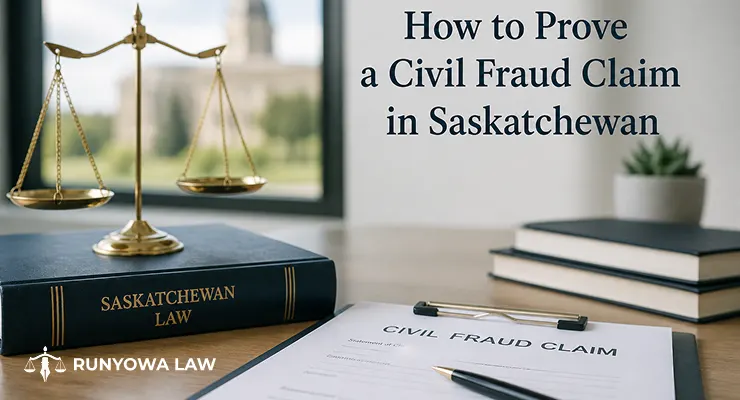
Civil fraud cases are among the most complex legal disputes in the country, requiring strong evidence, clear intent, and a well-structured legal argument. In civil fraud Canada, courts take fraud allegations very seriously because they involve intentional deception that leads to financial or personal loss. If you are wondering how to prove civil fraud in Saskatchewan, it is important to understand both the legal elements and the practical steps involved in building a strong case.
Whether you are an individual, investor, or business owner, knowing how fraud claims work can help you protect your rights and recover damages effectively.
Understanding Civil Fraud Canada: Legal Definition
Before diving into how to prove civil fraud, it’s important to understand what qualifies as fraud under Canadian law. Civil fraud occurs when one party knowingly makes a false statement with the intention of deceiving another party, causing them to suffer a loss.
Unlike criminal fraud, which must be proven beyond a reasonable doubt, civil fraud Canada cases are decided on the balance of probabilities. This means the court must be convinced that it is more likely than not that fraud took place.
A landmark Supreme Court decision established that fraud claims must meet specific legal criteria, which are consistently applied across provinces, including Saskatchewan.
Key Elements Required to Prove Civil Fraud Canada
To succeed in a fraud claim, you must prove all five essential elements. Missing even one can result in dismissal of your case.
1. False Representation
The defendant must have made a false statement or misrepresented a fact. This could include misleading financial data, false promises, or incorrect disclosures.
2. Knowledge of Falsity
The person making the statement must have known it was false or acted with reckless disregard for the truth.
3. Intent to Deceive
There must be a clear intention to mislead the other party. This is what separates fraud from simple negligence.
4. Reliance by the Plaintiff
You must show that you relied on the false statement when making a decision, such as investing money or signing a contract.
5. Resulting Damages
Finally, you must prove that you suffered measurable financial or personal loss due to the fraud.
Fact: Studies in Canadian civil litigation show that fraud-related cases have increased by nearly 20% in the last decade, especially in business and investment disputes.
How to Prove Civil Fraud in Saskatchewan: Step-by-Step Guide
If you are specifically dealing with how to prove civil fraud in Saskatchewan, the process involves a combination of legal strategy and factual evidence.
Step 1: Collect Strong and Admissible Evidence
Evidence is the foundation of any successful fraud claim. Courts in Saskatchewan require credible and well-documented proof.
Common types of evidence include:
- Emails, messages, and written communication
- Signed contracts and agreements
- Financial statements and bank records
- Witness testimonies
- Expert reports (for complex financial fraud)
Digital evidence plays a crucial role today, especially in cases involving online transactions or business dealings.
Step 2: Prove Intent and Knowledge
One of the most challenging parts of proving civil fraud Canada is demonstrating that the defendant intentionally deceived you.
Courts look for:
- Patterns of dishonest behavior
- Evidence of concealment
- Repeated false statements
- Inconsistencies in testimony
Even if direct proof is unavailable, circumstantial evidence can help establish intent.
Step 3: Show Clear Reliance on the False Statement
To win your case, you must demonstrate that you acted based on the defendant’s false representation.
For example:
- You invested money based on misleading information
- You entered into a contract under false assumptions
- You made financial decisions relying on incorrect data
Without reliance, the court may not consider the fraud claim valid.
Step 4: Calculate and Prove Damages
Damages are a critical part of civil fraud Canada claims. You must quantify your losses clearly.
This may include:
- Direct financial loss
- Loss of business opportunities
- Additional expenses caused by the fraud
- Legal and recovery costs
Example: Fraud claims in Canada can range from $5,000 to multi-million-dollar lawsuits, depending on the severity and scale of the deception.
Step 5: File Your Claim in Saskatchewan Court
To officially pursue your case:
- File a claim in the Court of King’s Bench for Saskatchewan
- Clearly outline all elements of fraud
- Attach all supporting documents
- Follow provincial civil procedure rules
Burden and Standard of Proof in Civil Fraud Cases
In civil fraud Canada, the burden of proof lies on the plaintiff. While the standard is lower than in criminal cases, courts still require clear, convincing, and cogent evidence.
Judges often apply stricter scrutiny because fraud allegations can significantly damage reputations and financial standing.
Common Challenges When Proving Civil Fraud
Understanding how to prove civil fraud in Saskatchewan also involves recognizing potential obstacles:
1. Lack of Direct Evidence
Fraud is often hidden, making it difficult to produce direct proof.
2. Complex Financial Structures
Business fraud cases may involve complicated transactions that require expert analysis.
3. Credibility Issues
If your statements are inconsistent, it may weaken your case.
4. Limitation Periods
In Saskatchewan, most fraud claims must be filed within two years of discovering the fraud.
Legal Remedies Available in Civil Fraud Canada
If you successfully prove fraud, Canadian courts may award several remedies:
Compensatory Damages
To recover financial losses suffered due to fraud.
Punitive Damages
To punish the defendant and deter similar behavior.
Rescission of Contracts
Cancelling agreements entered into under fraudulent conditions.
Constructive Trust
Recovering specific assets obtained through fraud.
Insight: Canadian courts are increasingly awarding punitive damages in fraud cases to discourage unethical business practices.
Real-Life Scenario: Understanding Fraud in Practice
Imagine a situation where a company presents false financial reports to attract investors. Based on this information, an individual invests $150,000. Later, it is discovered that the financial data was manipulated.
In this case:
- There was a false representation
- The company knew the data was false
- The intent was to deceive investors
- The investor relied on the information
- Financial loss occurred
This clearly meets all elements of civil fraud Canada.
Why You Should Seek Legal Advice
Although it is possible to understand how to prove civil fraud in Saskatchewan, fraud cases can be legally complex and time-consuming.
A qualified lawyer can:
- Assess the strength of your case
- Help gather admissible evidence
- Represent you in court
- Improve your chances of success
FAQs
1. What qualifies as civil fraud in Canada?
Civil fraud involves intentional deception that results in financial loss.
2. Can I file a fraud case without proof?
No, strong evidence is essential to succeed in a fraud claim.
3. How long does a fraud case take in Saskatchewan?
It can take several months to a few years, depending on complexity.
4. Can fraud cases be settled outside court?
Yes, many cases are resolved through settlements or mediation.
5. What damages can I recover?
You can recover financial losses, punitive damages, and sometimes specific assets.
Conclusion
Proving fraud requires more than just suspicion—it demands clear evidence, logical reasoning, and a strong legal foundation. In civil fraud Canada, courts expect plaintiffs to present convincing proof that clearly establishes each legal element, including intent, reliance, and measurable damages. By understanding these principles and following the correct approach for how to prove civil fraud in Saskatchewan, you can significantly strengthen your case and improve your chances of a favorable outcome.As highlighted by TAVENGWA RUNYOWA, taking timely action is critical, as delays can weaken evidence and impact legal rights. Gathering well-documented records, preserving communications, and seeking professional legal guidance are essential steps in building a strong claim. With the right preparation and strategy, you can effectively protect your interests, hold the responsible party accountable, and work toward recovering your financial losses through the legal system.